
A new chapter for civilisation, from Bangladesh to the world stage
4 September 2026 · 3 min read
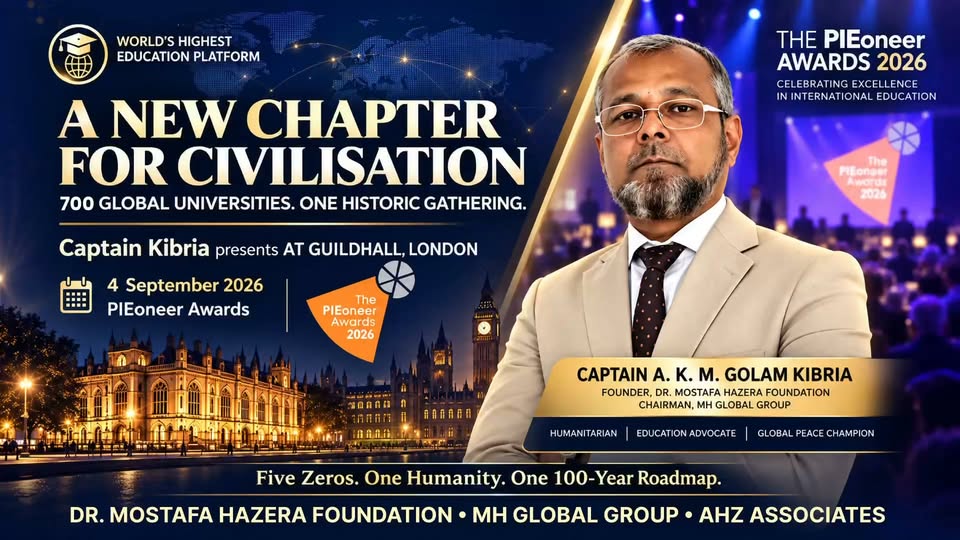
On 4 September 2026, at the historic Guildhall in London, Captain A. K. M. Golam Kibria, Founder of the Dr. Mostafa Hazera Foundation and Chairman of MH Global Group, presented the Foundation’s Five Zero Global Vision and 100-year Human Equity Civilisation roadmap at the PIEoneer Awards.
Before vice-chancellors, educators, innovators, and education leaders from around the world, he asked whether we can build a world in which, a hundred years from now, begging, homelessness, and illiteracy are no longer part of daily life, and remain only as museum history.
He pictured a child standing in a museum a century from now, looking at images of today’s hardship and asking, “Did people really once live like this?” History answers, “Yes, they did. But humanity decided to change.” That picture is one foundation of the Dr. Mostafa Hazera Foundation’s 100-year vision.
As artificial intelligence changes economies and the nature of work at extraordinary speed, he said the question is not only how intelligent technology becomes, but how humane civilisation becomes. Education, innovation, research, and conscience have to make sure that progress improves dignity, opportunity, and quality of life.
To carry the vision forward, he committed the Foundation to working, in stages, with 700 leading universities, bringing educators, researchers, innovators, and partners into one effort around education, research, innovation, artificial intelligence, and human dignity. His message was not to stop the AI revolution, but to give it a human purpose: to place in the next generation’s hands the power to build a better future, and to shape a civilisation in which some of humanity’s oldest suffering belongs only to the pages of history and to museums.
Universities have long created knowledge, formed leaders, and changed the course of civilisation. In his words, in the century ahead they can also lead in forming its conscience. The call from Guildhall is for humanity, not for one country or one institution. A thought that began in Bangladesh can become a global movement.
700 universities. Five zeros. One humanity. One 100-year vision. From Bangladesh to the world; let us work together so that today’s human suffering becomes tomorrow’s museum history.